May 31, 2026
Why Mortgage Rates Change Even When the Bank of England Doesn’t
Learn why mortgage rates change even when the Bank of England doesn’t. Explore UK swap rates, market expectations and fixed-rate pricing.
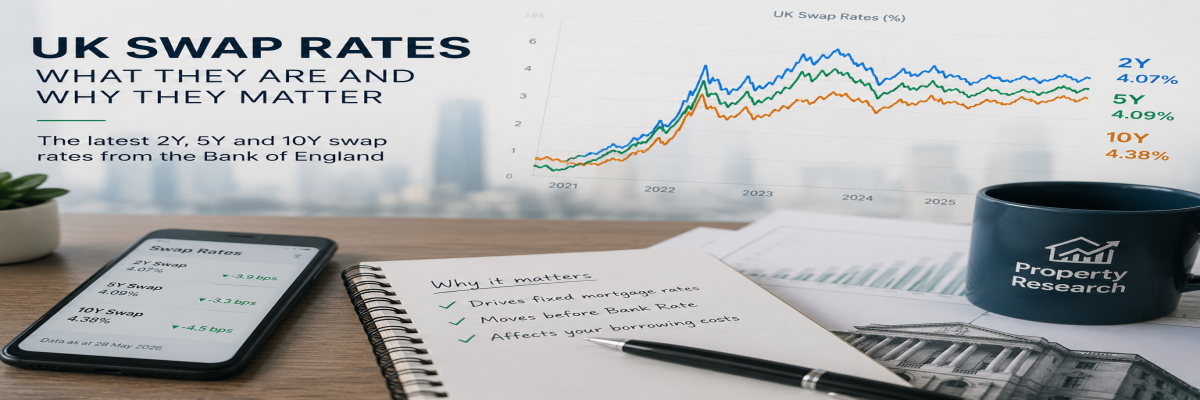
Table of contents
One of the questions I hear most often is:
“If the Bank of England hasn’t changed interest rates, why has my mortgage rate changed?”
It’s a fair question.
Many people assume that fixed mortgage rates move only when the Bank of England changes Base Rate. In reality, lenders are constantly adjusting their mortgage pricing based on what financial markets think will happen in the future, not just where rates are today.
This is where swap rates come in.
To help explain this, I’ve added a new UK Swap Rates section to PropertyResearch.uk. The page tracks daily 2-year, 5-year and 10-year UK swap rates and shows how they have moved over time alongside the Bank of England Base Rate. You can find it here - Swap Rates
A Real Example
My daughter is due to move into her new home next week.
Over the last few weeks she has received updated mortgage offer letters from Halifax regularly. Although the Bank of England has not been making weekly interest rate changes, her mortgage pricing has continued to improve.
Her 2-year fixed rate has fallen from 5.23% to 4.97% as she approaches completion.
That’s a reduction of 0.26 percentage points, or 26 basis points.
The obvious question is:
“Why did Halifax reduce the rate if Base Rate didn’t change?”
The answer is that lenders don’t simply look at today’s Bank Rate. They also look at wholesale funding costs and market expectations, which are heavily influenced by swap rates.
What Are Swap Rates?
In simple terms, swap rates are market interest rates that reflect expectations about future borrowing costs.
For example:
- 2-year swap rates are closely linked to pricing for 2-year fixed mortgages.
- 5-year swap rates are closely linked to pricing for 5-year fixed mortgages.
- 10-year swap rates provide a longer-term view of market expectations.
When swap rates fall, lenders often have room to reduce fixed mortgage pricing.
When swap rates rise, lenders may increase rates even if the Bank of England has not changed Base Rate.
Why This Matters
This is one of the reasons mortgage headlines can sometimes seem confusing.
You might see:
- The Bank of England leaves rates unchanged.
- Mortgage lenders cut fixed rates.
- New mortgage deals become cheaper.
Or the opposite:
- The Bank of England leaves rates unchanged.
- Mortgage lenders increase fixed rates.
Both situations can happen because swap rates reflect where markets think interest rates are heading in the future.
The New Swap Rates Page
The new page includes:
- Daily 2-year, 5-year and 10-year UK swap rates.
- Historical charts showing how swap rates have changed over time.
- A comparison against the Bank of England Base Rate.
- Plain-English explanations of what swap rates are and why they matter.
- Daily updates using Bank of England data.
The aim is to make one of the mortgage market’s most important indicators easier to understand for homeowners, buyers and anyone watching mortgage rates.
If you’ve ever wondered why your lender changes rates when the Bank of England hasn’t moved, the new Swap Rates section should help explain exactly what’s happening behind the scenes.

Lee Wisener CeMAP, CeRER, CeFAP, CSME
I am the owner of this site. If there is anything wrong, it's on me! If you want to get in touch, please email me at [email protected]. The site has grown so quickly, I honestly didnt expect the interest or the support, so thank you to everyone who has dropped me a line. More is coming, and I am spending time making it simpler, easier to understand, and also updating it regularly.

Comments (0)
Want to comment on this page? Login or Register.