Insights

UK Swap Rates Today

Track the latest UK 2-year, 5-year and 10-year SONIA swap rates and see what recent wholesale moves may mean for fixed mortgage pricing.

Swap rates are one of the main market inputs lenders watch when pricing fixed mortgages. This page focuses on the latest available Bank of England data, recent momentum and the wider mortgage context without adding noise.

Data uses the Bank of England Overnight Index Swap curve, based on SONIA. Longer-term OIS data, including 10 year rates, is only available from late 2021 onwards.

Latest available date: 23 Jul 2026
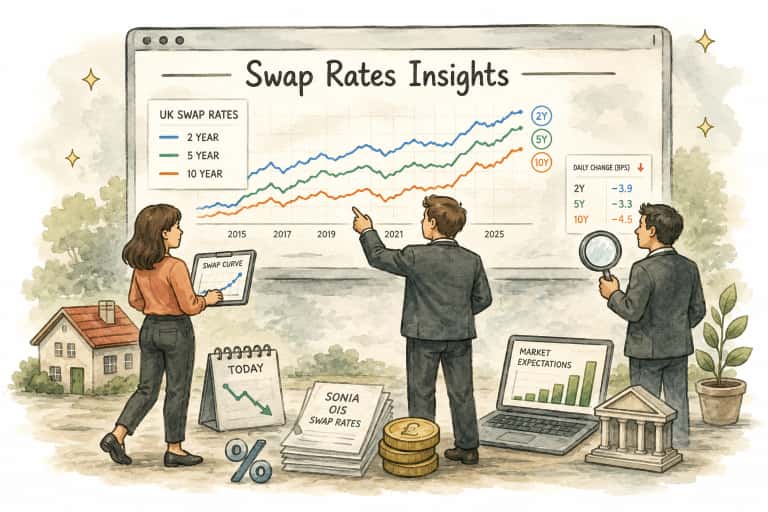
UK swap rates illustration

Mortgage Market Summary

Overall signal: Worsening On the latest trading day, 2Y, 5Y and 10Y swap rates all moved higher.

Wholesale mortgage pricing pressure has firmed slightly. If this continues, lenders could have less room to reduce fixed-rate mortgage pricing.

2Y Swap

4.35%

Rising over 5 days

+6.0 bps on latest move

As at: 23 Jul 2026

Last 30 available points

52 week range

3.31% - 4.40%

5-day change: +0.12 pts

5Y Swap

4.41%

Rising over 5 days

+6.4 bps on latest move

As at: 23 Jul 2026

Last 30 available points

52 week range

3.49% - 4.43%

5-day change: +0.12 pts

10Y Swap

4.65%

Stable over 5 days

+4.8 bps on latest move

As at: 23 Jul 2026

Last 30 available points

52 week range

3.88% - 4.71%

5-day change: +0.10 pts

Mortgage Context

What this means for mortgages

Swap rates are wholesale market rates lenders watch when pricing fixed mortgages.

When swap rates fall, pressure on fixed mortgage pricing can ease, which may give some lenders room to trim rates.

When swap rates rise, mortgage price cuts can become less likely and some lenders may face more pressure to reprice higher.

Mortgage rates do not move perfectly with swaps. Lenders also consider margins, funding costs, competition, service levels and risk appetite before changing deals.

Understanding Swaps

Why swap rates matter before Bank Rate moves

The Bank of England Bank Rate has the clearest direct effect on tracker mortgages and standard variable rates.

Fixed mortgage pricing reacts more quickly to changes in market expectations, and swap rates are one of the clearest signals of that shift.

That is why fixed deals can move even when Bank Rate is unchanged. Markets can price in future rate expectations before the next MPC decision arrives.

Main Chart

UK swap rates over time

2Y, 5Y and 10Y SONIA/OIS swap rates from the Bank of England.

Comparison

Bank Rate vs swap rates

This shows why fixed mortgage pricing can move before the Bank of England changes Base Rate.

Percent per annum

Current Rates

Current UK Swap Rates

Term Rate Latest movement 5-day change As at
2 Year 4.35% +6.0 bps +11.8 bps 23 Jul 2026
5 Year 4.41% +6.4 bps +11.6 bps 23 Jul 2026
10 Year 4.65% +4.8 bps +9.9 bps 23 Jul 2026

Updated on UK business days when new Bank of England data is available. Weekends and market gaps use the latest available records.

FAQ

Swap rate questions

What are swap rates?

Swap rates are wholesale market interest rates that help lenders judge the cost of offering fixed-rate lending over different time periods.

Why do swap rates matter for mortgages?

They are one of the main market inputs behind fixed mortgage pricing, so sustained moves in swaps can influence whether lenders cut, hold or raise deals.

Do mortgage rates change immediately when swap rates move?

Not always. Lenders also consider margins, competition, funding costs and risk before changing mortgage pricing.

What is the difference between Bank Rate and swap rates?

Bank Rate is the official rate set by the Bank of England. Swap rates reflect market expectations for future rates and tend to matter more for fixed mortgages.